
Updated 28 July 2026
How are Oyster mushroom doing in Edinburgh and Lothians this July?
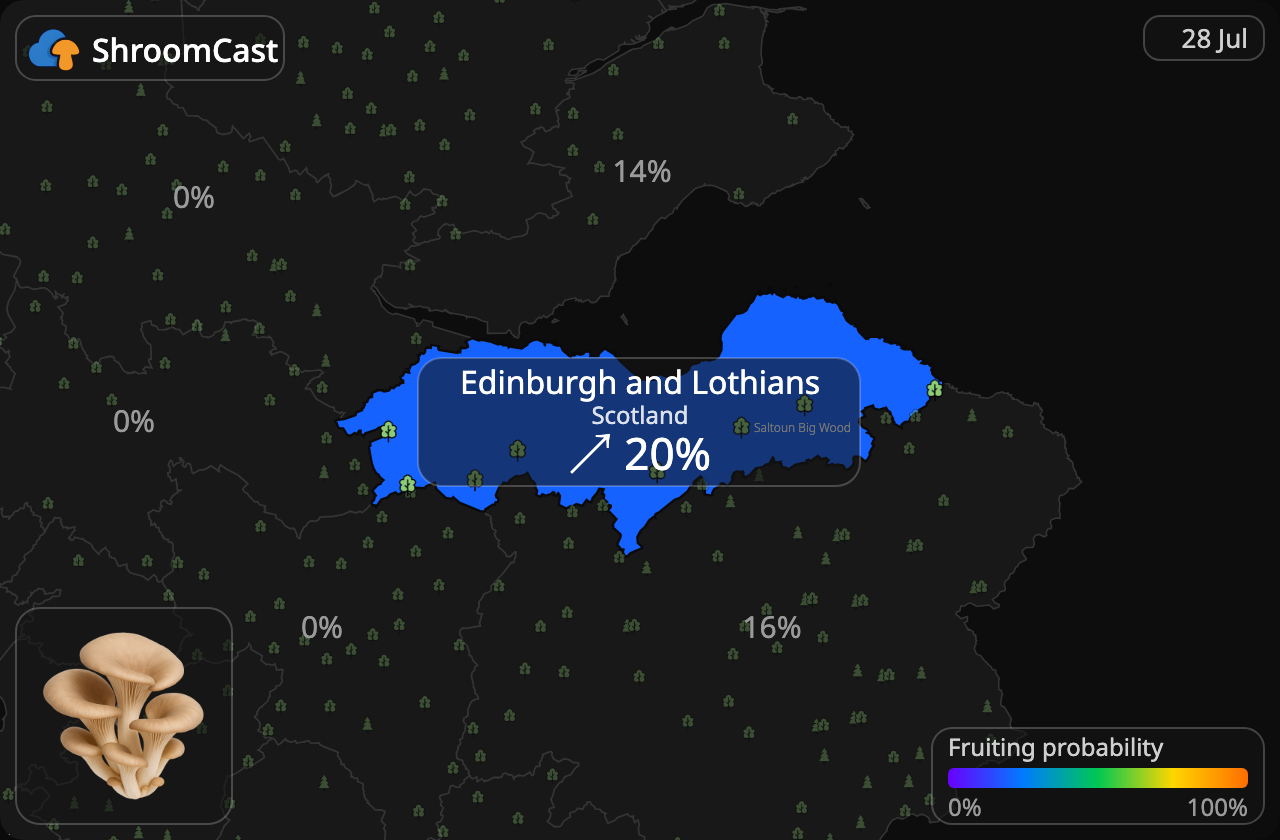
The best time for oyster mushroom in Scotland is January to December, with the peak normally in the middle of that range. Today they’re at 20% and building in Edinburgh and Lothians
The oyster name covers a group of related mushrooms with members for nearly every season. Alongside the cold-loving Pleurotus ostreatus, the pale or summer oyster Pleurotus pulmonarius fruits from late spring through summer on the same kinds of dead hardwood, so a warm-season find here is genuine and the forecast reflects this wider group.
Fan-shaped or oyster-shell cap, usually 5 to 15 cm across, in shades of grey, brown, blue-grey or cream. White decurrent gills run down a short stubby off-centre stem or attach almost directly to the wood, and the flesh has a mild pleasant smell.
Tear into strips and pan-fry hard in butter or oil until the edges crisp and brown, then season with salt and a little garlic. They also work well in stir-fries, folded through risotto or pasta, or added to soups and stews where their firm texture holds up. Cook them thoroughly as they are not eaten raw.
Can be confused with the angel’s wings (Pleurocybe porrigens), which is white, thinner and grows on conifer wood and has caused poisoning, so check the substrate and colour. The mild bitter oysterling (Panellus) and lung oyster are smaller and less fleshy but not dangerous.
Edinburgh and the Lothians sit on the southern shore of the Firth of Forth, where a fertile coastal lowland of farmland and river valleys like the Water of Leith rises gently inland to the rolling Pentland Hills and, eastward, the Lammermuirs. Volcanic outcrops such as Arthur’s Seat and the Castle Rock punctuate the city itself, giving a varied mosaic of coast, town and upland in a small area. Woodland here is mostly broadleaf and mixed: mature beech, oak, birch and hazel in estate policies and glens such as Roslin Glen and Dalkeith Country Park, alongside Scots pine and conifer plantations on the higher ground. Damp riverside woods, parkland edges and grassy commons are the productive ground, yielding chanterelles, ceps, hedgehog fungi and field and parasol mushrooms in season.
The region has a cool, temperate maritime climate, with mild winters, modest summers and rain spread through the year, though the eastern Lothians are among the drier, sunnier parts of Scotland thanks to a sheltering rain shadow. Reliable autumn moisture combined with that comparative dryness makes for a steady rather than torrential fungal season. Foragers can expect an accessible, varied season across woodland, parkland and coastal grassland, all close to the city and easily reached on foot or by a short trip into East and Midlothian. Autumn is the peak, with grassland waxcaps on old pastures and golf links a regional highlight alongside the usual woodland boletes and chanterelles.
FAQ
Does ShroomCast tell me if a mushroom is safe to eat or identify it for me?
No. ShroomCast only forecasts timing, so it tells you when oyster mushroom are likely to be fruiting in Edinburgh and Lothians, Scotland. It does not identify mushrooms, and it cannot tell you whether anything you pick is safe to eat. Always confirm your own identification from a reliable source before eating anything.
How does the live oyster mushroom forecast for Edinburgh and Lothians, Scotland work?
We take the usual oyster mushroom season for Edinburgh and Lothians, Scotland (January to December) and weigh it against the weather right now and over the last few days. That gives you one live number, today 20% and building, plus a 14-day outlook and a normal-year line to compare against.
When is oyster mushroom season in Edinburgh and Lothians, Scotland?
In Edinburgh and Lothians, Scotland, oyster mushroom season usually runs January to December. The exact start shifts year to year with rain and temperature, so some years they show up early and some years late. Right now (July) the live forecast for Edinburgh and Lothians, Scotland reads 20% and conditions are building.
Where do oyster mushroom grow in Edinburgh and Lothians, Scotland?
Grows in overlapping shelves on dead and dying broadleaf trees, especially beech and poplar, on stumps, logs and standing trunks. It is a wood-rotting fungus and does not grow on the ground. They tend to come back to the same kinds of ground year after year, so once you find good cover it is worth checking again. ShroomCast does not share exact spots; it tells you the timing for Edinburgh and Lothians, Scotland so you know when it is worth heading out.
How do I know oyster mushroom season has started in Edinburgh and Lothians, Scotland?
Season usually kicks off after a warm spell followed by steady rain, with the first flushes appearing somewhere in the January to December window. The clearest sign is the live forecast lifting off zero into ‘just starting’ or ‘building’. For Edinburgh and Lothians, Scotland it currently sits at 20% and is building.
See the live regional forecast in the ShroomCast app.
Scale: 0-20% very low · 20-40% low · 40-60% moderate · 60-80% high · 80-100% excellent. ShroomCast forecasts fruiting probability from weather, soil, forests and years of observations – a guide, not a guarantee of finds.