
Updated 14 September 2026
Are Oyster out in Argyll and Bute yet?
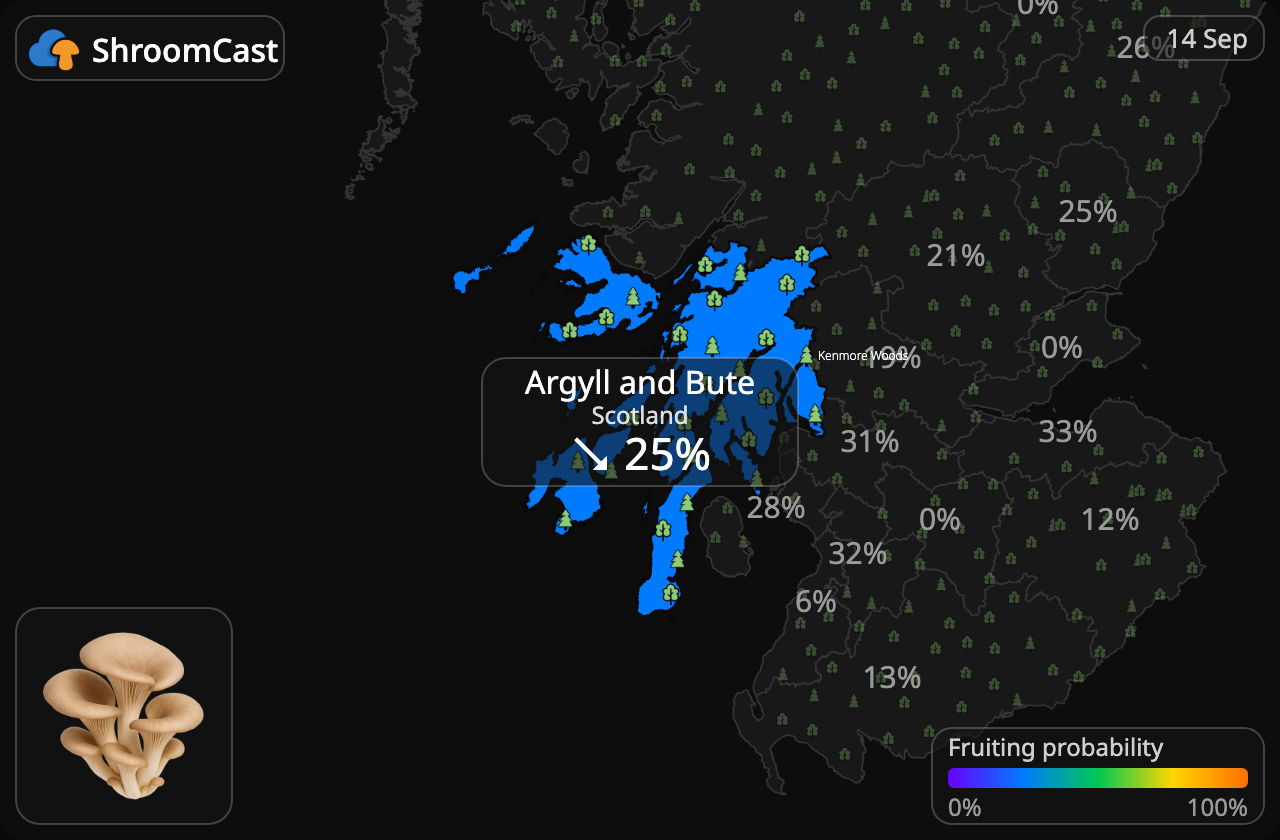
Mushroom season in Argyll and Bute, Scotland is building right now, with oyster sitting at 25% today. The typical season runs January to December, and we’re in September now
The oyster name covers a group of related mushrooms with members for nearly every season. Alongside the cold-loving Pleurotus ostreatus, the pale or summer oyster Pleurotus pulmonarius fruits from late spring through summer on the same kinds of dead hardwood, so a warm-season find here is genuine and the forecast reflects this wider group.
It grows on dead and dying hardwood, especially beech, poplar, willow, oak and aspen, appearing on standing trunks, fallen logs and stumps rather than on the ground. It favours damp deciduous and mixed woodland, parks and riverside trees where dead wood is plentiful.
Keep fresh caps in a paper bag in the fridge for up to about five days, avoiding sealed plastic which makes them slimy. They dry well in a dehydrator or warm airy spot, and cooked oysters can be frozen; raw freezing tends to make them watery.
Can be confused with the angel’s wings (Pleurocybella porrigens), which is white, thinner and grows on conifer wood and has caused poisoning, so check the substrate and colour. The mild bitter oysterling (Panellus) and lung oyster are smaller and less fleshy but not dangerous.
Argyll and Bute is a deeply indented stretch of Scotland’s west coast, where sea lochs like Loch Fyne and Loch Etive cut between rugged hills, peninsulas such as Kintyre and Cowal, and a scatter of islands including Mull, Islay and Bute. Rocky shorelines, heather moorland and steep glens dominate, with few areas of flat ground. Much of the region carries commercial Sitka spruce plantations, but there are also pockets of native oak, birch and hazel, including the lush Atlantic oakwoods around Loch Sunart and the Argyll rainforest. Mushrooms turn up along forest tracks and clearings, in mossy native woods and on the mosaic of moor and rough grazing.
This is one of the wettest, mildest parts of Britain, washed by the Atlantic and warmed by the Gulf Stream, with heavy rainfall spread through the year and high humidity. These damp, frost-poor conditions keep the ground moist and suit fungi well, supporting the temperate rainforest character of the western glens. Foragers can expect a long, productive autumn season, with chanterelles and ceps among the conifers and a rich variety of fungi in the old oakwoods. The terrain is wet and often remote, so good boots and an eye on the tides and weather pay off.
FAQ
Does ShroomCast tell me if a mushroom is safe to eat or identify it for me?
No. ShroomCast only forecasts timing, so it tells you when oyster are likely to be fruiting in Argyll and Bute, Scotland. It does not identify mushrooms, and it cannot tell you whether anything you pick is safe to eat. Always confirm your own identification from a reliable source before eating anything.
How does the live oyster forecast for Argyll and Bute, Scotland work?
We take the usual oyster season for Argyll and Bute, Scotland (January to December) and weigh it against the weather right now and over the last few days. That gives you one live number, today 25% and building, plus a 14-day outlook and a normal-year line to compare against.
When is oyster season in Argyll and Bute, Scotland?
In Argyll and Bute, Scotland, oyster season usually runs January to December. The exact start shifts year to year with rain and temperature, so some years they show up early and some years late. Right now (September) the live forecast for Argyll and Bute, Scotland reads 25% and conditions are building.
Where do oyster grow in Argyll and Bute, Scotland?
Grows in overlapping shelves on dead and dying broadleaf trees, especially beech and poplar, on stumps, logs and standing trunks. It is a wood-rotting fungus and does not grow on the ground. They tend to come back to the same kinds of ground year after year, so once you find good cover it is worth checking again. ShroomCast does not share exact spots; it tells you the timing for Argyll and Bute, Scotland so you know when it is worth heading out.
How do I know oyster season has started in Argyll and Bute, Scotland?
Season usually kicks off after a warm spell followed by steady rain, with the first flushes appearing somewhere in the January to December window. The clearest sign is the live forecast lifting off zero into ‘just starting’ or ‘building’. For Argyll and Bute, Scotland it currently sits at 25% and is building.
See the live regional forecast in the ShroomCast app.
This page shows today. The app gives you the full 14-day outlook for your area and all 14 species, so you can pick the right day before you drive out.


Scale: 0-20% very low · 20-40% low · 40-60% moderate · 60-80% high · 80-100% excellent. ShroomCast forecasts fruiting probability from weather, soil, forests and years of observations – a guide, not a guarantee of finds.
ShroomCast forecasts the region and the time of year. It cannot identify mushrooms for you, so confirm any species with a reliable source before eating it.