
Updated 23 September 2026
How are Saffron doing in Gotland this September?
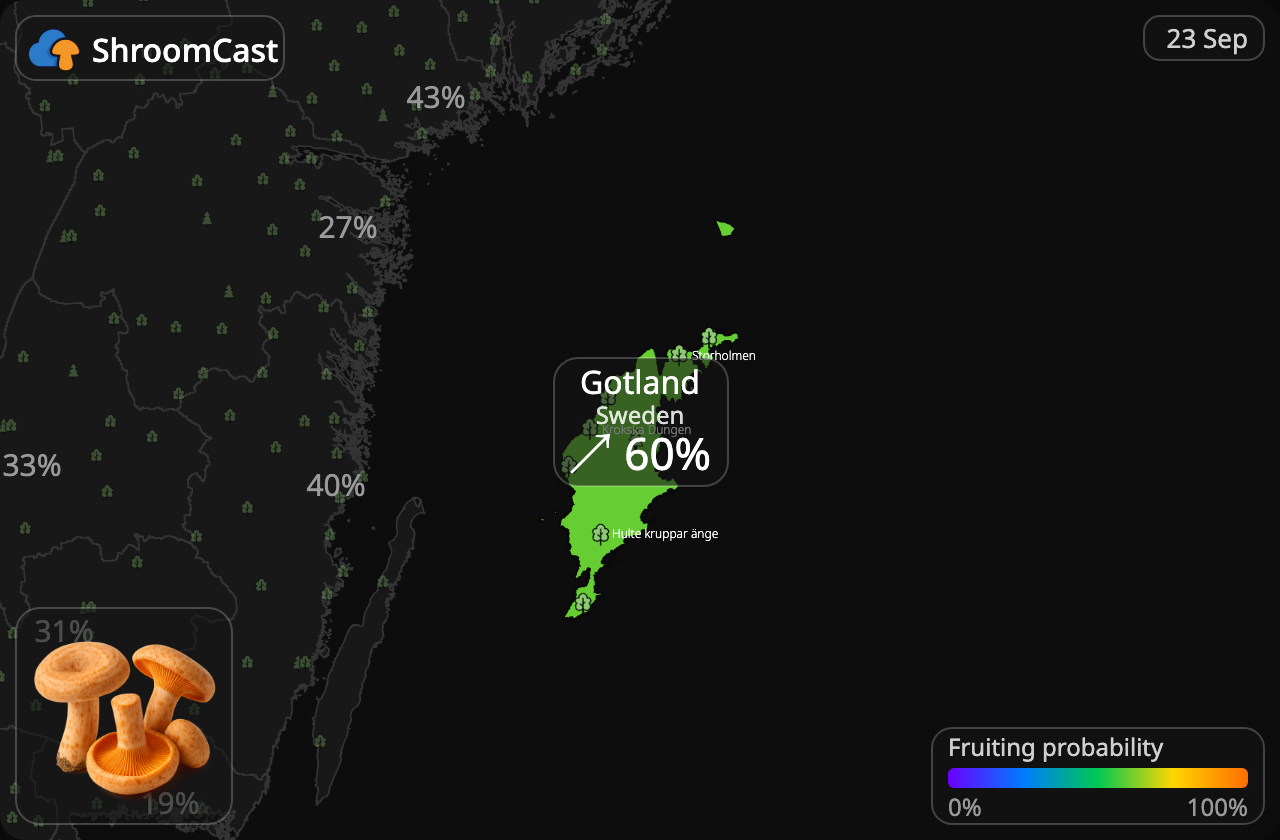
The best time for saffron in Sweden is August to November, with the peak normally in the middle of that range. Today they’re at 60% and looking good in Gotland
It fruits in late summer and autumn after steady rain, when daytime temperatures cool into roughly the 10 to 18 C range. A good soaking followed by mild, settled days usually brings a flush within a week or two.
Eating a good quantity of saffron milkcaps can turn your urine a harmless reddish or orange colour, which surprises first-time foragers.
Use fresh within a couple of days, stored loosely in a paper bag in the fridge rather than sealed plastic. They cook down and freeze well once fried, and are also excellent salted or pickled in brine, which is the classic way to keep them.
Other orange milkcaps in the same group, notably the false saffron milkcap (Lactarius deterrimus) under spruce, which is also edible but blander and reddens more strongly. The key safety point is that all the orange-milk Lactarius are edible; there is no deadly lookalike, but do not confuse it with milkcaps that bleed white milk, which can be acrid or upsetting.
Gotland is Sweden’s largest island, a flat limestone plateau in the Baltic Sea fringed by long coastlines, sandy and stony beaches, and the famous raukar sea stacks. Inland, thin-soiled alvar plains, shallow valleys and low rises give the island its open, gently rolling character. Woodland is dominated by Scots pine and spruce, mixed with birch, hazel and plenty of oak and ash, often growing thinly over bare limestone. Mossy pine heaths, calcareous alvar grasslands and damp deciduous groves provide the varied, lime-rich habitats that fungi favour.
Buffered by the surrounding Baltic, Gotland has one of Sweden’s mildest and sunniest climates, with warm summers and comparatively low rainfall. Autumn moisture off the sea, rather than heavy rain, tends to drive the main mushroom flushes. Foragers can expect chanterelles and porcini in the pine and mixed woods, with the lime-rich soils favouring calcicole species that are uncommon on the mainland. Much of the island is open and easy to walk, but allemansrätten still applies, so keep clear of crops, fenced pasture and nature reserves.
FAQ
Is it mushroom season in Gotland, Sweden right now?
For saffron in Gotland, Sweden, the typical season is August to November, and today the live forecast reads 60% with conditions looking good this September. So yes or no depends on the day and the weather, which is exactly what the forecast tracks.
Does ShroomCast tell me if a mushroom is safe to eat or identify it for me?
No. ShroomCast only forecasts timing, so it tells you when saffron are likely to be fruiting in Gotland, Sweden. It does not identify mushrooms, and it cannot tell you whether anything you pick is safe to eat. Always confirm your own identification from a reliable source before eating anything.
How does the live saffron forecast for Gotland, Sweden work?
We take the usual saffron season for Gotland, Sweden (August to November) and weigh it against the weather right now and over the last few days. That gives you one live number, today 60% and looking good, plus a 14-day outlook and a normal-year line to compare against.
When is saffron season in Gotland, Sweden?
In Gotland, Sweden, saffron season usually runs August to November. The exact start shifts year to year with rain and temperature, so some years they show up early and some years late. Right now (September) the live forecast for Gotland, Sweden reads 60% and conditions are looking good.
Where do saffron grow in Gotland, Sweden?
Grows on the ground in conifer woods, almost always under pine, often on sandy or calcareous soil. It is a mycorrhizal partner of pine and tends to appear in scattered troops. They tend to come back to the same kinds of ground year after year, so once you find good cover it is worth checking again. ShroomCast does not share exact spots; it tells you the timing for Gotland, Sweden so you know when it is worth heading out.
See the live regional forecast in the ShroomCast app.
This page shows today. The app gives you the full 14-day outlook for your area and all 14 species, so you can pick the right day before you drive out.


Scale: 0-20% very low · 20-40% low · 40-60% moderate · 60-80% high · 80-100% excellent. ShroomCast forecasts fruiting probability from weather, soil, forests and years of observations – a guide, not a guarantee of finds.
ShroomCast forecasts the region and the time of year. It cannot identify mushrooms for you, so confirm any species with a reliable source before eating it.