
Updated 13 September 2026
Is it Porcini season in Finistère right now?
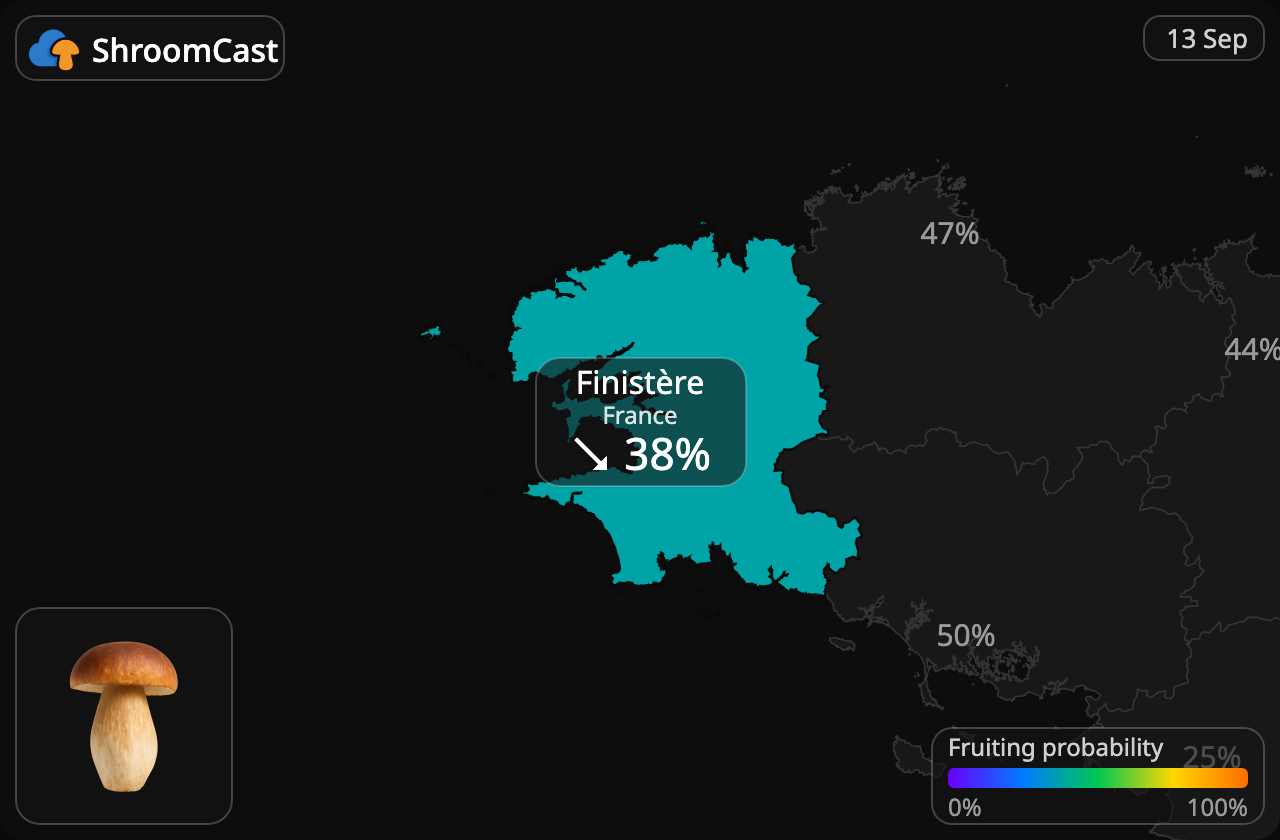
Mushroom season in Finistère, France is building right now, with porcini sitting at 38% today. The typical season runs August to November, and we’re in September now
Fruits after warm, humid spells when soil temperatures sit in the mid teens Celsius and a good soaking rain follows a warm period. A typical trigger is heavy rain after several warm days, with flushes appearing roughly one to two weeks later.
Grows in mycorrhizal partnership with trees, especially under pine, spruce, birch, beech and oak, on well drained soil. Found in conifer and broadleaf woodland and along woodland edges and tracks.
Slice young firm caps thin and fry in butter with garlic and parsley, or add to risotto and pasta sauces. Older or wormy specimens are best dried and ground into a powder to deepen stocks, soups and gravies.
Can be confused with the bitter bolete (Tylopilus felleus), which has a darker net on the stem, pinkish pores when mature and a strongly bitter taste, and with red pored boletes. Avoid any bolete with red or orange pores or flesh that stains strongly blue.
Finistère forms the westernmost tip of Brittany, a granite peninsula thrust into the Atlantic with a deeply indented coast of cliffs, rias and abers. Inland rise the low, ancient ridges of the Monts d’Arrée and Montagnes Noires, cloaked in heath and peat bog, with a patchwork bocage of hedged fields between. Though Brittany is lightly wooded, Finistère holds fine oak and beech forests such as the Cranou and Huelgoat, the latter strewn with mossy granite boulders. Sessile oak, beech, chestnut and birch grow on damp, acidic granite soils, forming rich mycorrhizal ground, while hedgerows and conifer plantations add further habitat.
The climate is thoroughly oceanic – mild, humid and wet, driven by Atlantic westerlies. Rain falls year-round and coastal frost is rare, so autumns stay long, damp and gentle. These mild, moist conditions extend the fungal season well into late autumn, with flushes possible from late summer onward. Foragers work the acidic oak and beech woods of the interior for girolles (chanterelles) and cèpes, with birch boletes on heathy margins and trompettes de la mort in shaded beech litter. Bocage hedgerows, mossy Huelgoat boulders and damp valley floors all reward searching through a long, mild autumn.
FAQ
Is it mushroom season in Finistère, France right now?
For porcini in Finistère, France, the typical season is August to November, and today the live forecast reads 38% with conditions building this September. So yes or no depends on the day and the weather, which is exactly what the forecast tracks.
Does ShroomCast tell me if a mushroom is safe to eat or identify it for me?
No. ShroomCast only forecasts timing, so it tells you when porcini are likely to be fruiting in Finistère, France. It does not identify mushrooms, and it cannot tell you whether anything you pick is safe to eat. Always confirm your own identification from a reliable source before eating anything.
How does the live porcini forecast for Finistère, France work?
We take the usual porcini season for Finistère, France (August to November) and weigh it against the weather right now and over the last few days. That gives you one live number, today 38% and building, plus a 14-day outlook and a normal-year line to compare against.
When is porcini season in Finistère, France?
In Finistère, France, porcini season usually runs August to November. The exact start shifts year to year with rain and temperature, so some years they show up early and some years late. Right now (September) the live forecast for Finistère, France reads 38% and conditions are building.
Where do porcini grow in Finistère, France?
Grows in mycorrhizal partnership with trees, especially under pine, spruce, birch, beech and oak, on well drained soil. Found in conifer and broadleaf woodland and along woodland edges and tracks. They tend to come back to the same kinds of ground year after year, so once you find good cover it is worth checking again. ShroomCast does not share exact spots; it tells you the timing for Finistère, France so you know when it is worth heading out.
See the live regional forecast in the ShroomCast app.
This page shows today. The app gives you the full 14-day outlook for your area and all 14 species, so you can pick the right day before you drive out.


Scale: 0-20% very low · 20-40% low · 40-60% moderate · 60-80% high · 80-100% excellent. ShroomCast forecasts fruiting probability from weather, soil, forests and years of observations – a guide, not a guarantee of finds.
ShroomCast forecasts the region and the time of year. It cannot identify mushrooms for you, so confirm any species with a reliable source before eating it.