
Updated 13 September 2026
When will Chanterelle appear in Gävleborg?
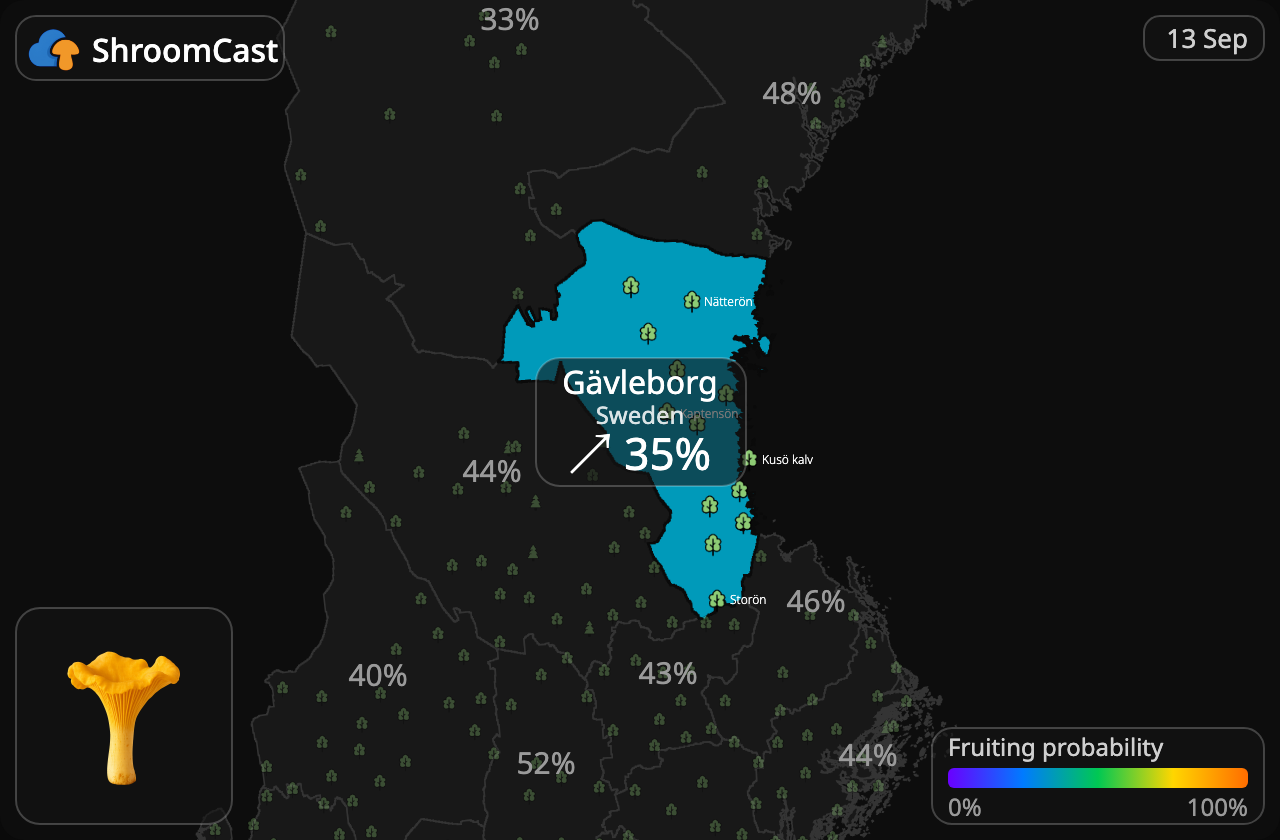
Chanterelle usually come up in Gävleborg from June to October, and right now they’re at 35% and building.
Fruits in warm, humid weather a week or two after steady summer rain, typically when soil stays moist and temperatures sit around 15 to 20 C. A wet spell breaking a dry period often brings a flush.
Grows on the ground in deciduous and coniferous woodland, in a mycorrhizal partnership with trees such as oak, beech, birch and pine. It often appears in mossy ground, on banks and along path edges, frequently coming back in the same spots year after year.
An excellent edible with firm flesh and a mild, slightly peppery and fruity flavour. It is good fried in butter and works well with eggs, in sauces and cream dishes; cook it gently as it can release water, and avoid overcooking which toughens it.
The main dangerous lookalike is the Jack o’lantern (Omphalotus illudens, and the European Omphalotus olearius), which is toxic and causes severe sickness; it grows in clumps on wood or stumps and has true sharp gills rather than blunt forked ridges. The false chanterelle (Hygrophoropsis aurantiaca) is also confused with it but has thinner, true gills and a more orange colour, and is best avoided.
Gävleborg stretches from a low, skerry-strewn coast on the Gulf of Bothnia inland to the forested hills and river valleys of Gästrikland and Hälsingland in southern Norrland. The land rises gradually westward, threaded by the Ljusnan and Dalälven rivers and dotted with countless lakes and bogs. This is one of Sweden’s most heavily wooded regions, blanketed in boreal taiga of Norway spruce and Scots pine with birch and aspen mixed in. Mushrooms thrive in the mossy spruce stands, along damp lake and bog margins, and in older mixed forest where the canopy stays cool and shaded.
The climate is humid continental, with cold snowy winters and warm summers that bring frequent rain inland. The reliable late-summer moisture and heavy morning dew make for dependable fungal flushes once the heat eases. Foraging here is generous and uncrowded, helped by Sweden’s right of public access (allemansrätten) that lets you pick freely in the forests. Expect classic Nordic harvests of porcini, chanterelles and other boletes from late summer into autumn, with the inland spruce forests and lake shores being the most productive ground.
FAQ
When is chanterelle season in Gävleborg, Sweden?
In Gävleborg, Sweden, chanterelle season usually runs June to October. The exact start shifts year to year with rain and temperature, so some years they show up early and some years late. Right now (September) the live forecast for Gävleborg, Sweden reads 35% and conditions are building.
Where do chanterelle grow in Gävleborg, Sweden?
Grows on the ground in deciduous and coniferous woodland, in a mycorrhizal partnership with trees such as oak, beech, birch and pine. It often appears in mossy ground, on banks and along path edges, frequently coming back in the same spots year after year. They tend to come back to the same kinds of ground year after year, so once you find good cover it is worth checking again. ShroomCast does not share exact spots; it tells you the timing for Gävleborg, Sweden so you know when it is worth heading out.
How do I know chanterelle season has started in Gävleborg, Sweden?
Season usually kicks off after a warm spell followed by steady rain, with the first flushes appearing somewhere in the June to October window. The clearest sign is the live forecast lifting off zero into ‘just starting’ or ‘building’. For Gävleborg, Sweden it currently sits at 35% and is building.
Are chanterelle out near me right now in Gävleborg, Sweden?
Today the chanterelle forecast for Gävleborg, Sweden is 35% and conditions are building. That is a live read for the region this September, and it shifts with the weather rather than following a fixed calendar. It tells you if it is worth heading out in Gävleborg, Sweden right now.
What should I look for this week for chanterelle in Gävleborg, Sweden?
This week in Gävleborg, Sweden the forecast is 35% and building. Grows on the ground in deciduous and coniferous woodland, in a mycorrhizal partnership with trees such as oak, beech, birch and pine. It often appears in mossy ground, on banks and along path edges, frequently coming back in the same spots year after year. The 14-day outlook on the page shows whether conditions are climbing toward a flush or easing off, so you can pick your day.
See the live regional forecast in the ShroomCast app.
This page shows today. The app gives you the full 14-day outlook for your area and all 14 species, so you can pick the right day before you drive out.


Scale: 0-20% very low · 20-40% low · 40-60% moderate · 60-80% high · 80-100% excellent. ShroomCast forecasts fruiting probability from weather, soil, forests and years of observations – a guide, not a guarantee of finds.
ShroomCast forecasts the region and the time of year. It cannot identify mushrooms for you, so confirm any species with a reliable source before eating it.