
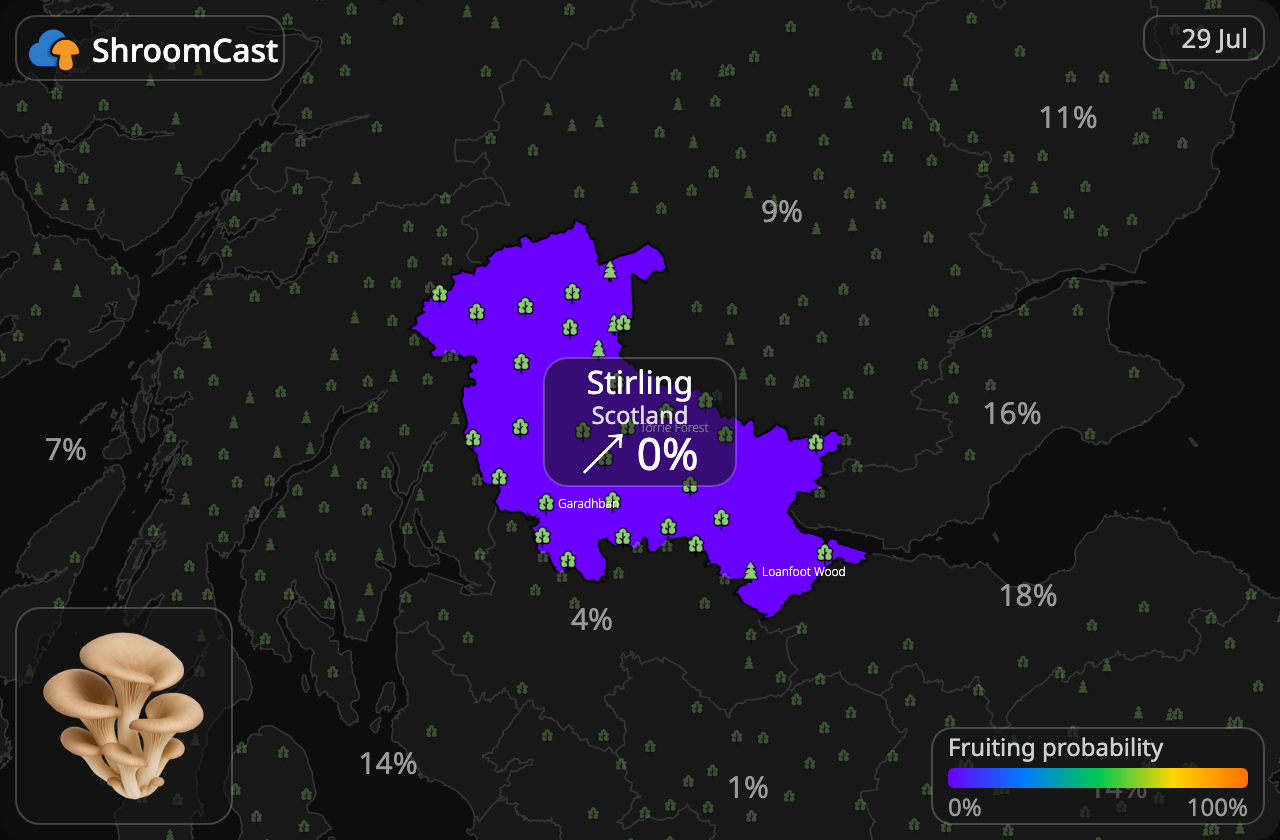
Updated 29 July 2026
When is the best time to find Oyster mushroom in Stirling?
The best time for oyster mushroom in Scotland is January to December, with the peak normally in the middle of that range. Today they’re at 0% and just starting in Stirling
The oyster name covers a group of related mushrooms with members for nearly every season. Alongside the cold-loving Pleurotus ostreatus, the pale or summer oyster Pleurotus pulmonarius fruits from late spring through summer on the same kinds of dead hardwood, so a warm-season find here is genuine and the forecast reflects this wider group.
Mainly autumn to winter, and it can appear in mild spells through the colder months. Frost often triggers a flush.
Keep fresh caps in a paper bag in the fridge for up to about five days, avoiding sealed plastic which makes them slimy. They dry well in a dehydrator or warm airy spot, and cooked oysters can be frozen; raw freezing tends to make them watery.
Can be confused with the angel’s wings (Pleurocybe porrigens), which is white, thinner and grows on conifer wood and has caused poisoning, so check the substrate and colour. The mild bitter oysterling (Panellus) and lung oyster are smaller and less fleshy but not dangerous.
Stirling straddles the Highland Boundary Fault, where the flat, fertile carse of the Forth Valley meets rising ground in every direction. To the north-east the Ochil Hills climb steeply above the plain, while westward the land breaks up into the lochs and wooded glens of the Trossachs and the eastern half of the Loch Lomond and The Trossachs National Park. Native oak and birch woodland clothes the hillsides and glens around the Trossachs, mixed with stands of hazel, rowan and alder along the burns. Large conifer plantations of Sitka spruce and pine cover much of the upland forestry ground, and these damp, mossy edges between native and planted woodland are prime mushroom habitat.
The climate is cool, mild and consistently wet, with the hills wringing heavy rainfall out of the moist Atlantic air that funnels up the Forth Valley. Damp ground and high humidity keep the woods reliably moist, which suits fungi through a long autumn season. Expect classic damp Scottish woodland foraging: chanterelles and ceps under birch and pine, with plenty of ground to roam between the carse-edge woods and the national-park glens. Much of the best habitat lies within the Loch Lomond and The Trossachs National Park, so forage responsibly and stick to access-land etiquette.
FAQ
Is it mushroom season in Stirling, Scotland right now?
For oyster mushroom in Stirling, Scotland, the typical season is January to December, and today the live forecast reads 0% with conditions just starting this July. So yes or no depends on the day and the weather, which is exactly what the forecast tracks.
Does ShroomCast tell me if a mushroom is safe to eat or identify it for me?
No. ShroomCast only forecasts timing, so it tells you when oyster mushroom are likely to be fruiting in Stirling, Scotland. It does not identify mushrooms, and it cannot tell you whether anything you pick is safe to eat. Always confirm your own identification from a reliable source before eating anything.
How does the live oyster mushroom forecast for Stirling, Scotland work?
We take the usual oyster mushroom season for Stirling, Scotland (January to December) and weigh it against the weather right now and over the last few days. That gives you one live number, today 0% and just starting, plus a 14-day outlook and a normal-year line to compare against.
When is oyster mushroom season in Stirling, Scotland?
In Stirling, Scotland, oyster mushroom season usually runs January to December. The exact start shifts year to year with rain and temperature, so some years they show up early and some years late. Right now (July) the live forecast for Stirling, Scotland reads 0% and conditions are just starting.
Where do oyster mushroom grow in Stirling, Scotland?
Grows in overlapping shelves on dead and dying broadleaf trees, especially beech and poplar, on stumps, logs and standing trunks. It is a wood-rotting fungus and does not grow on the ground. They tend to come back to the same kinds of ground year after year, so once you find good cover it is worth checking again. ShroomCast does not share exact spots; it tells you the timing for Stirling, Scotland so you know when it is worth heading out.
See the live regional forecast in the ShroomCast app.
This page shows today. The app gives you the full 14-day outlook for your area and all 14 species, so you can pick the right day before you drive out.


Scale: 0-20% very low · 20-40% low · 40-60% moderate · 60-80% high · 80-100% excellent. ShroomCast forecasts fruiting probability from weather, soil, forests and years of observations – a guide, not a guarantee of finds.