
Updated 24 September 2026
When will Porcini appear in Pisa?
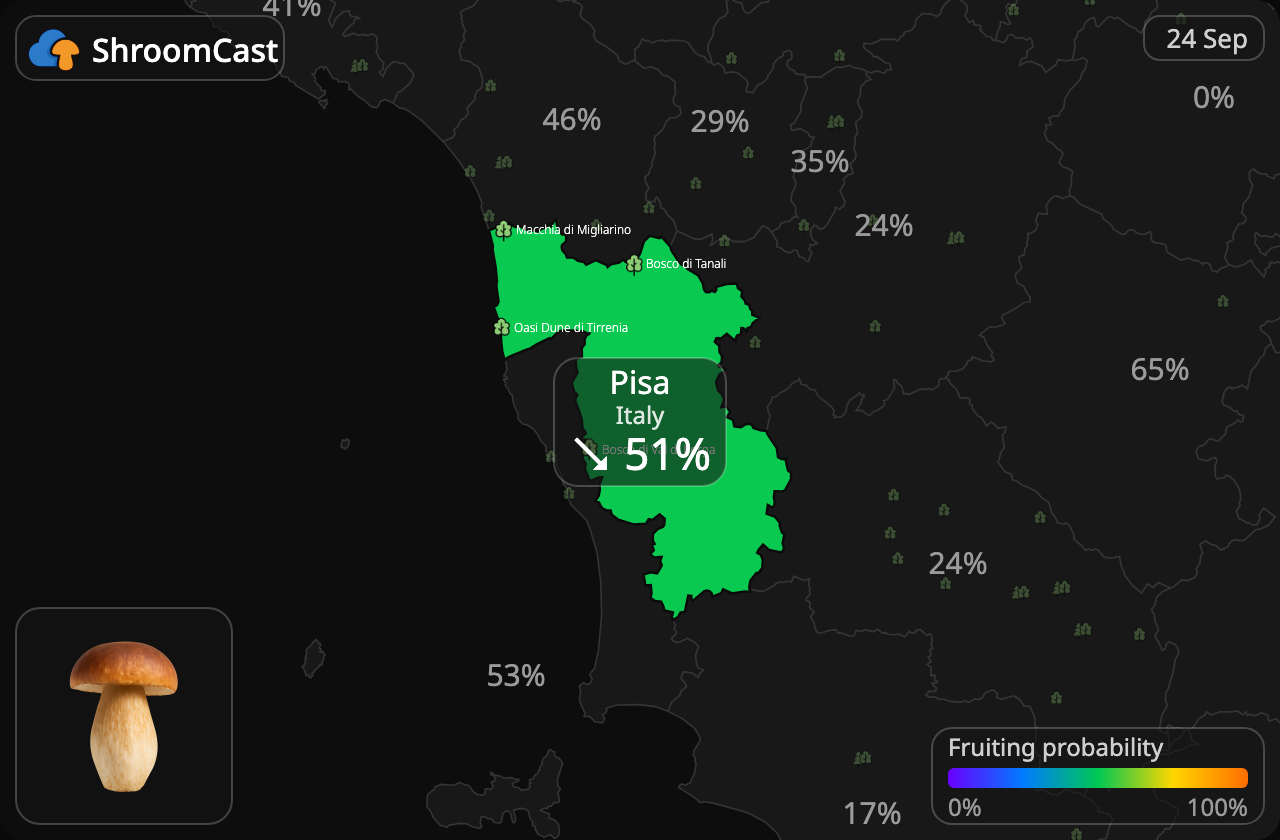
This week’s porcini forecast for Pisa, Italy reads 51% and looking good. The 14-day outlook decides whether to go now or wait, so check https://shroomcast.net/forecast/penny-bun-cep-forecast-for-pisa-italy/ before you set out
Fruits after warm, humid spells when soil temperatures sit in the mid teens Celsius and a good soaking rain follows a warm period. A typical trigger is heavy rain after several warm days, with flushes appearing roughly one to two weeks later.
Brown bun shaped cap, often greasy when damp. The underside has a sponge of pores, white at first then turning yellowish to olive, never red. The thick bulbous stem is pale with a fine raised white network near the top, and the flesh is white and does not change colour when cut. Smell is pleasant and nutty.
Often shares ground with chanterelles, other boletes like the bay bolete, and amanitas including the toxic fly agaric and death cap, so identify everything carefully. The reddish fly agaric under birch and pine is a useful indicator that conditions may suit cep nearby.
One of the finest edible mushrooms, with a deep savoury nutty flavour. Excellent fresh in risotto, sauces and fried in butter, and it dries very well to concentrate the flavour for stocks and soups.
Check around the bases of host trees and along sunlit forest edges, returning to productive spots a few days apart through the flush. Cut or twist the stem cleanly, slice each cap to check for maggots, and take only young specimens with white firm flesh.
Can be confused with the bitter bolete (Tylopilus felleus), which has a darker net on the stem, pinkish pores when mature and a strongly bitter taste, and with red pored boletes. Avoid any bolete with red or orange pores or flesh that stains strongly blue.
FAQ
When is porcini season in Pisa, Italy?
In Pisa, Italy, porcini season usually runs August to November. The exact start shifts year to year with rain and temperature, so some years they show up early and some years late. Right now (September) the live forecast for Pisa, Italy reads 51% and conditions are looking good.
Where do porcini grow in Pisa, Italy?
Grows in mycorrhizal partnership with trees, especially under pine, spruce, birch, beech and oak, on well drained soil. Found in conifer and broadleaf woodland and along woodland edges and tracks. They tend to come back to the same kinds of ground year after year, so once you find good cover it is worth checking again. ShroomCast does not share exact spots; it tells you the timing for Pisa, Italy so you know when it is worth heading out.
How do I know porcini season has started in Pisa, Italy?
Season usually kicks off after a warm spell followed by steady rain, with the first flushes appearing somewhere in the August to November window. The clearest sign is the live forecast lifting off zero into ‘just starting’ or ‘building’. For Pisa, Italy it currently sits at 51% and is looking good.
Are porcini out near me right now in Pisa, Italy?
Today the porcini forecast for Pisa, Italy is 51% and conditions are looking good. That is a live read for the region this September, and it shifts with the weather rather than following a fixed calendar. It tells you if it is worth heading out in Pisa, Italy right now.
What should I look for this week for porcini in Pisa, Italy?
This week in Pisa, Italy the forecast is 51% and looking good. Grows in mycorrhizal partnership with trees, especially under pine, spruce, birch, beech and oak, on well drained soil. Found in conifer and broadleaf woodland and along woodland edges and tracks. The 14-day outlook on the page shows whether conditions are climbing toward a flush or easing off, so you can pick your day.
See the live regional forecast in the ShroomCast app.
This page shows today. The app gives you the full 14-day outlook for your area and all 14 species, so you can pick the right day before you drive out.


Scale: 0-20% very low · 20-40% low · 40-60% moderate · 60-80% high · 80-100% excellent. ShroomCast forecasts fruiting probability from weather, soil, forests and years of observations – a guide, not a guarantee of finds.
ShroomCast forecasts the region and the time of year. It cannot identify mushrooms for you, so confirm any species with a reliable source before eating it.