
Updated 13 September 2026
Oyster in Greater London, England: live forecast and 14-day outlook
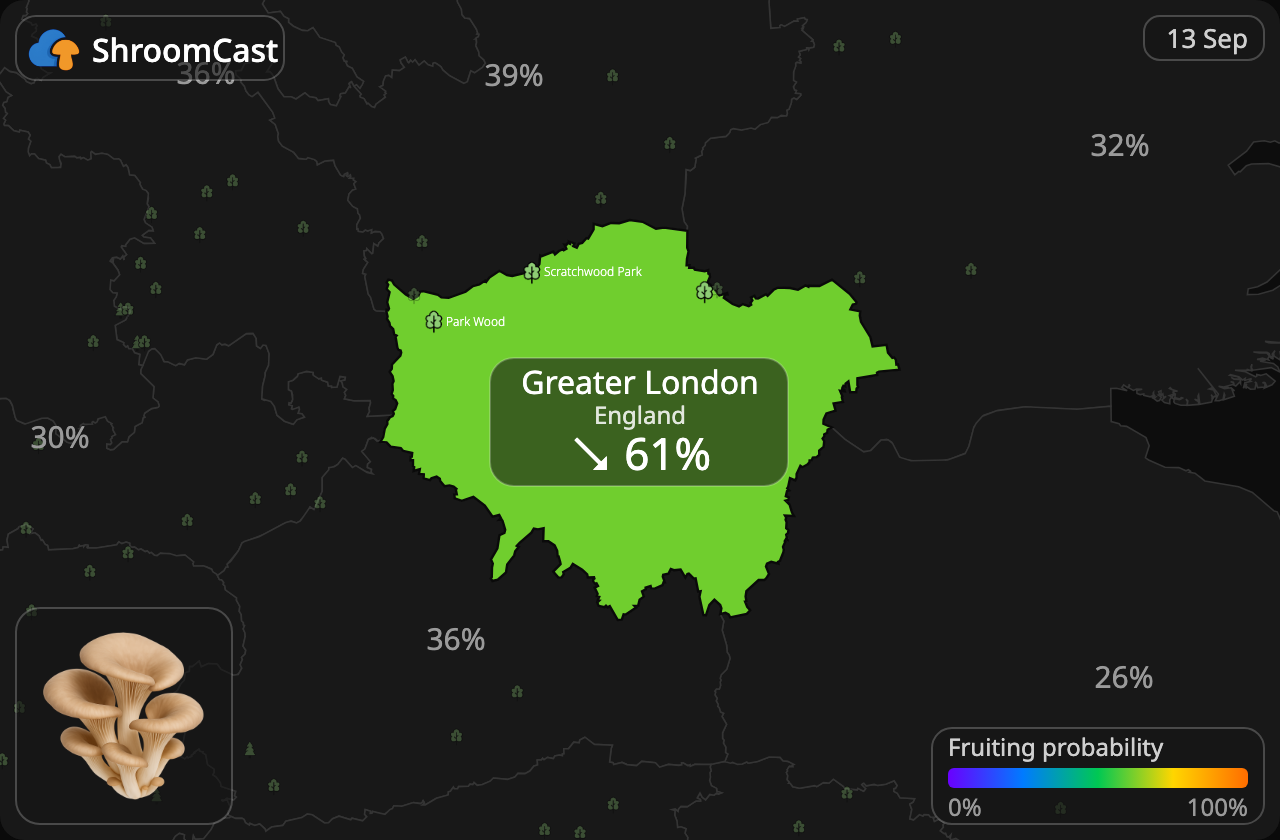
The best time for oyster in England is January to December, with the peak normally in the middle of that range. Today they’re at 61% and looking good in Greater London
The oyster name covers a group of related mushrooms with members for nearly every season. Alongside the cold-loving Pleurotus ostreatus, the pale or summer oyster Pleurotus pulmonarius fruits from late spring through summer on the same kinds of dead hardwood, so a warm-season find here is genuine and the forecast reflects this wider group.
On the same dead hardwood you may find other wood-rotters such as turkey tail, jelly ear and velvet shank, which also fruit in the cold months. The similar branched oyster and pale oyster grow in comparable spots, and on conifers you should expect look-alikes rather than true oysters.
Look for overlapping shelf-like clusters on tree trunks and logs, often high up, and check the underside for decurrent gills that run down a short off-centre stem. Pick young specimens that are still firm and pale, as old ones turn tough, leathery and prone to insect larvae.
Can be confused with the angel’s wings (Pleurocybella porrigens), which is white, thinner and grows on conifer wood and has caused poisoning, so check the substrate and colour. The mild bitter oysterling (Panellus) and lung oyster are smaller and less fleshy but not dangerous.
Greater London occupies the broad, low-lying floor of the Thames Basin, straddling the tidal River Thames and its tributaries like the Lea and Wandle. Beyond the built-up core, the land rises gently into wooded commons and green-belt fringes such as Hampstead Heath and the Epping ridge. Ancient woods and royal parks dominate the green spaces here, with oak, beech, birch and hornbeam, plus famous old pollards in Epping Forest and sweet chestnut on the heaths. Look for fungi among leaf litter under the trees, on old hardwood logs, and in the unimproved grassland of commons like Richmond Park and Wimbledon Common, where waxcaps appear.
London has a mild, temperate maritime climate, slightly warmer and drier than the surrounding countryside thanks to the urban heat island. Rainfall is moderate but spread through the year, and damp, mild autumns reliably trigger fungal flushes. Foraging in London means working the large parks, heaths and ancient commons rather than wild country, so expect competition and local picking restrictions in many royal parks. Autumn brings a good variety in the better woodlands, but always check the rules for each site before collecting.
FAQ
Where do oyster grow in Greater London, England?
Grows in overlapping shelves on dead and dying broadleaf trees, especially beech and poplar, on stumps, logs and standing trunks. It is a wood-rotting fungus and does not grow on the ground. They tend to come back to the same kinds of ground year after year, so once you find good cover it is worth checking again. ShroomCast does not share exact spots; it tells you the timing for Greater London, England so you know when it is worth heading out.
How do I know oyster season has started in Greater London, England?
Season usually kicks off after a warm spell followed by steady rain, with the first flushes appearing somewhere in the January to December window. The clearest sign is the live forecast lifting off zero into ‘just starting’ or ‘building’. For Greater London, England it currently sits at 61% and is looking good.
Are oyster out near me right now in Greater London, England?
Today the oyster forecast for Greater London, England is 61% and conditions are looking good. That is a live read for the region this September, and it shifts with the weather rather than following a fixed calendar. It tells you if it is worth heading out in Greater London, England right now.
What should I look for this week for oyster in Greater London, England?
This week in Greater London, England the forecast is 61% and looking good. Grows in overlapping shelves on dead and dying broadleaf trees, especially beech and poplar, on stumps, logs and standing trunks. It is a wood-rotting fungus and does not grow on the ground. The 14-day outlook on the page shows whether conditions are climbing toward a flush or easing off, so you can pick your day.
Is it mushroom season in Greater London, England right now?
For oyster in Greater London, England, the typical season is January to December, and today the live forecast reads 61% with conditions looking good this September. So yes or no depends on the day and the weather, which is exactly what the forecast tracks.
See the live regional forecast in the ShroomCast app.
This page shows today. The app gives you the full 14-day outlook for your area and all 14 species, so you can pick the right day before you drive out.


Scale: 0-20% very low · 20-40% low · 40-60% moderate · 60-80% high · 80-100% excellent. ShroomCast forecasts fruiting probability from weather, soil, forests and years of observations – a guide, not a guarantee of finds.
ShroomCast forecasts the region and the time of year. It cannot identify mushrooms for you, so confirm any species with a reliable source before eating it.