
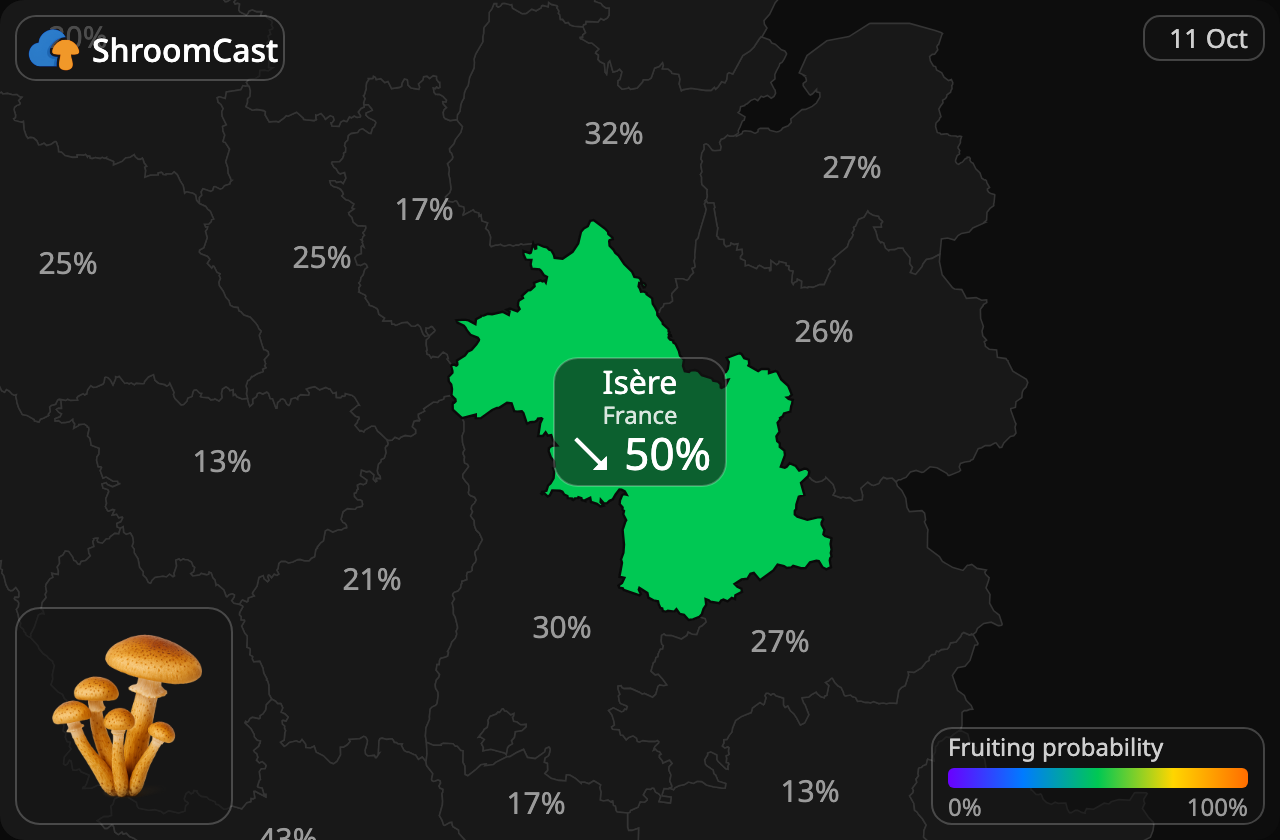
Updated 11 October 2026
Is it Honey season in Isère right now?
The best time for honey in France is September to November, with the peak normally in the middle of that range. Today they’re at 50% and looking good in Isère
It fruits in autumn after the first cool, damp spells, typically once nights drop to around 5 to 12 C following steady rain. A wet late September through November in temperate Europe brings the biggest flushes.
It grows in clusters on and around living and dead hardwood, favouring stumps, buried roots and the bases of trees in broadleaf and mixed woodland, parks and gardens. It is a parasite and decomposer, so look at the foot of oak, beech and other trees as well as on rotting wood lying on the ground.
Pick only firm young caps before they open fully, take the caps and leave the tough fibrous stems, and harvest from a fresh flush rather than ageing slimy clusters. Confirm the white spore print, the ring on the stem and the black rhizomorph bootlaces under the bark, since several similar clustered woodland mushrooms can be confused with it.
Can be confused with the deadly funeral bell (Galerina marginata), which also grows on wood but is smaller, has a rusty-brown spore print and lacks the dense tufted clumps and dark cap scales. It is also worth separating from the sheathed woodtuft (Kuehneromyces mutabilis) and from species of Pholiota.
Isère runs from the flat Rhône valley plains and the Bièvre lowlands in the west to the limestone massifs of the Vercors and Chartreuse and the crystalline peaks of Belledonne and the Écrins in the east. The Isère river carves the broad Grésivaudan valley past Grenoble, where basins meet steep slopes rising above 4,000 metres. Beech and silver fir cloak the Vercors and Chartreuse plateaux on limestone, mixed with spruce higher up, while oak, chestnut and pine hold the warmer lower slopes and the Terres Froides. This range of soils and altitudes, from calcareous ridges to acidic crystalline massifs, gives fungi a long succession of habitats.
Grenoble’s sheltered basins bring hot summers, cold winters and marked temperature inversions, while rainfall climbs steadily with altitude across the massifs. Damp, cooling autumns after summer storms trigger the main flush, and the spring thaw feeds the morel season on the valley floors. Autumn is the peak, when the beech-fir forests of the Vercors and Chartreuse yield ceps and porcini, chanterelles and black trumpets on the leaf litter. Spring brings morels to the alluvial woods and poplar stands of the Isère and Drac valleys, while lower oak and chestnut woods add further boletes.
FAQ
Are honey out near me right now in Isère, France?
Today the honey forecast for Isère, France is 50% and conditions are looking good. That is a live read for the region this October, and it shifts with the weather rather than following a fixed calendar. It tells you if it is worth heading out in Isère, France right now.
What should I look for this week for honey in Isère, France?
This week in Isère, France the forecast is 50% and looking good. Grows in dense clumps at the base of living and dead broadleaved trees, on stumps and on buried roots, where it is a parasite and wood-rotting fungus. Most often on oak, beech and other hardwoods, sometimes on conifers. The 14-day outlook on the page shows whether conditions are climbing toward a flush or easing off, so you can pick your day.
Is it mushroom season in Isère, France right now?
For honey in Isère, France, the typical season is September to November, and today the live forecast reads 50% with conditions looking good this October. So yes or no depends on the day and the weather, which is exactly what the forecast tracks.
Does ShroomCast tell me if a mushroom is safe to eat or identify it for me?
No. ShroomCast only forecasts timing, so it tells you when honey are likely to be fruiting in Isère, France. It does not identify mushrooms, and it cannot tell you whether anything you pick is safe to eat. Always confirm your own identification from a reliable source before eating anything.
How does the live honey forecast for Isère, France work?
We take the usual honey season for Isère, France (September to November) and weigh it against the weather right now and over the last few days. That gives you one live number, today 50% and looking good, plus a 14-day outlook and a normal-year line to compare against.
See the live regional forecast in the ShroomCast app.
This page shows today. The app gives you the full 14-day outlook for your area and all 14 species, so you can pick the right day before you drive out.


Scale: 0-20% very low · 20-40% low · 40-60% moderate · 60-80% high · 80-100% excellent. ShroomCast forecasts fruiting probability from weather, soil, forests and years of observations – a guide, not a guarantee of finds.
ShroomCast forecasts the region and the time of year. It cannot identify mushrooms for you, so confirm any species with a reliable source before eating it.