
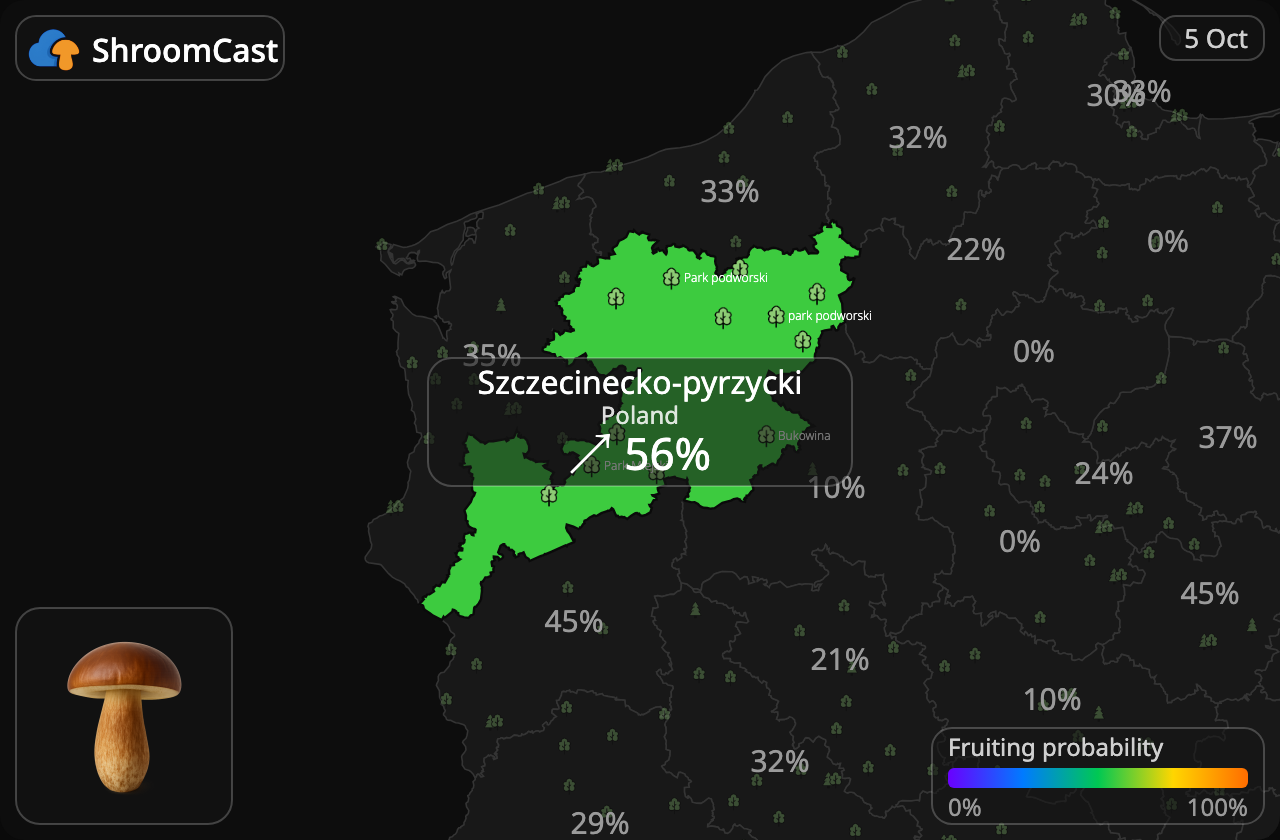
Updated 5 October 2026
Bay Bolete in Szczecinecko-pyrzycki, Poland: live forecast and 14-day outlook
The best time for bay bolete in Poland is August to November, with the peak normally in the middle of that range. Today they’re at 56% and looking good in Szczecinecko-pyrzycki
It fruits after late summer and autumn rain once soil temperatures have cooled, typically from August through November. A good soaking followed by mild, humid days brings flushes, and it tolerates cooler conditions better than many boletes, often fruiting late into the season.
The cap is dark chestnut to bay brown, slightly sticky when wet and matt when dry, usually 5 to 15 cm across. The underside has pores, not gills, which are pale yellow turning greenish and bruise blue-green when pressed; the stem is brownish, paler than the cap, with fine streaks and no ring.
Often shares acidic conifer ground with other edibles such as the slippery jack, larch bolete and saffron milkcap, and you may find it near chanterelles in mossy patches. In the same beech and oak woods you may also encounter ceps and other Boletus species.
A reliable test is to press or bruise the pale yellow pores, which slowly stain blue-grey, then fade; this and the bay-brown cap help separate it from the bitter Tylopilus felleus. Pick young specimens with firm flesh, as older caps quickly become spongy and waterlogged, and check for maggots in the stem before bagging.
Use fresh within a day or two, kept loosely in a paper bag in the fridge rather than sealed plastic. It dries very well sliced thin on a rack or low oven, and the rehydrated pieces plus their soaking liquid keep good flavour; sliced caps can also be sauteed and frozen.
It can be confused with the cep (Boletus edulis), which is also edible, but the bay bolete is darker brown and its pores bruise blue-green whereas cep pores do not. No common European bolete with which it is confused is deadly, but always check that the pores are not red or orange and that any blueing is slow, to rule out the few unpleasant blue-staining boletes.
FAQ
How do I know bay bolete season has started in Szczecinecko-pyrzycki, Poland?
Season usually kicks off after a warm spell followed by steady rain, with the first flushes appearing somewhere in the August to November window. The clearest sign is the live forecast lifting off zero into ‘just starting’ or ‘building’. For Szczecinecko-pyrzycki, Poland it currently sits at 56% and is looking good.
Are bay bolete out near me right now in Szczecinecko-pyrzycki, Poland?
Today the bay bolete forecast for Szczecinecko-pyrzycki, Poland is 56% and conditions are looking good. That is a live read for the region this October, and it shifts with the weather rather than following a fixed calendar. It tells you if it is worth heading out in Szczecinecko-pyrzycki, Poland right now.
What should I look for this week for bay bolete in Szczecinecko-pyrzycki, Poland?
This week in Szczecinecko-pyrzycki, Poland the forecast is 56% and looking good. Grows in conifer woodland, especially with pine and spruce, and sometimes under beech and oak on acidic, often sandy or mossy ground. It is mycorrhizal and frequently fruits on or beside rotting stumps and conifer litter. The 14-day outlook on the page shows whether conditions are climbing toward a flush or easing off, so you can pick your day.
Is it mushroom season in Szczecinecko-pyrzycki, Poland right now?
For bay bolete in Szczecinecko-pyrzycki, Poland, the typical season is August to November, and today the live forecast reads 56% with conditions looking good this October. So yes or no depends on the day and the weather, which is exactly what the forecast tracks.
Does ShroomCast tell me if a mushroom is safe to eat or identify it for me?
No. ShroomCast only forecasts timing, so it tells you when bay bolete are likely to be fruiting in Szczecinecko-pyrzycki, Poland. It does not identify mushrooms, and it cannot tell you whether anything you pick is safe to eat. Always confirm your own identification from a reliable source before eating anything.
See the live regional forecast in the ShroomCast app.
This page shows today. The app gives you the full 14-day outlook for your area and all 14 species, so you can pick the right day before you drive out.


Scale: 0-20% very low · 20-40% low · 40-60% moderate · 60-80% high · 80-100% excellent. ShroomCast forecasts fruiting probability from weather, soil, forests and years of observations – a guide, not a guarantee of finds.
ShroomCast forecasts the region and the time of year. It cannot identify mushrooms for you, so confirm any species with a reliable source before eating it.