
Updated 23 September 2026
When will Parasol appear in Norfolk?
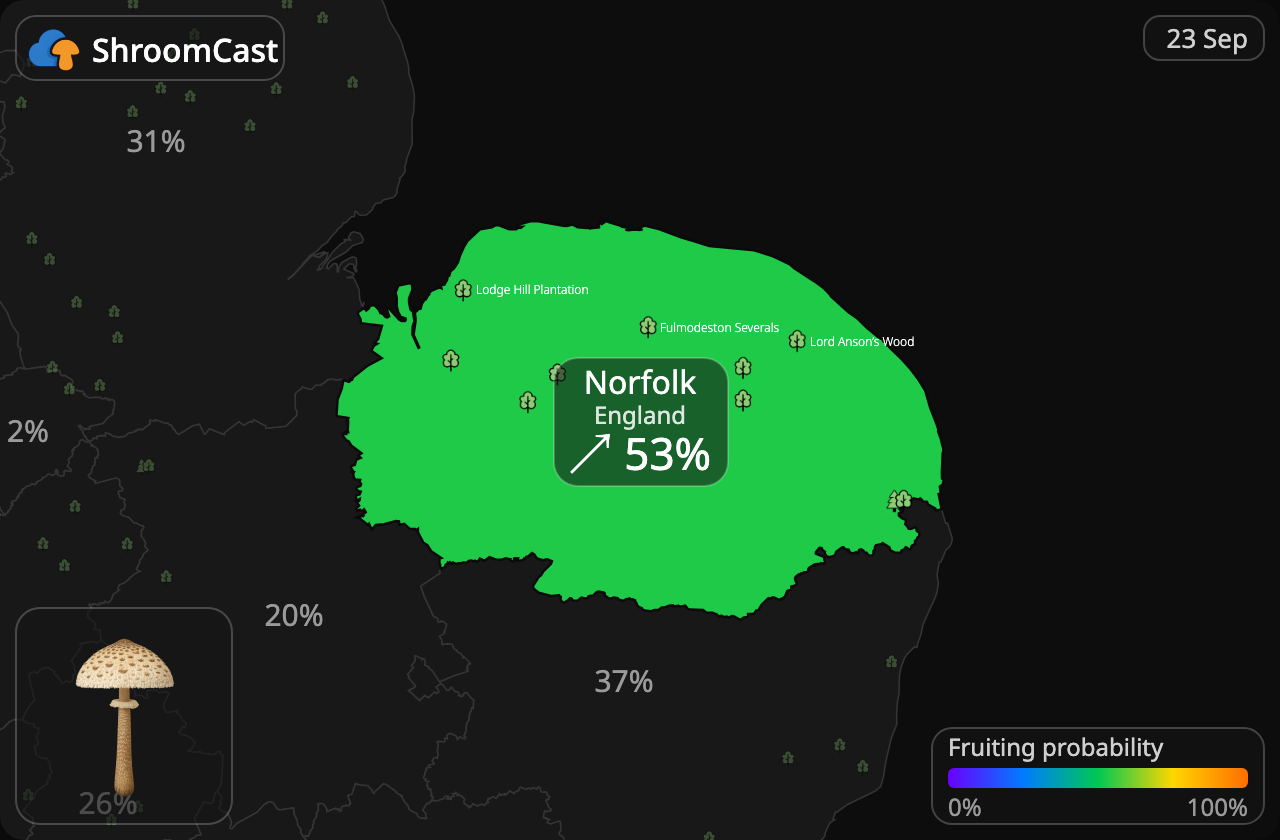
The best time for parasol in England is August to October, with the peak normally in the middle of that range. Today they’re at 53% and looking good in Norfolk
Fruits in late summer and autumn after warm spells broken by steady rain, typically when daytime temperatures sit around 12 to 20 C. A few days of moisture following a warm period usually triggers a flush.
A mature cap can reach 30 cm or more across, making it one of the largest gilled mushrooms in Europe, and the loose ring really does slide freely up and down the stem.
A prized edible with a mild, slightly nutty taste. The caps are good dusted in flour or breadcrumbs and fried whole like a schnitzel; the fibrous stems are usually too tough to eat and are discarded.
Can be confused with members of the genus Chlorophyllum, especially Chlorophyllum brunneum and the American Chlorophyllum molybdites, which cause stomach upsets. The parasol is told apart by its tall snakeskin-patterned stem, a movable double-edged ring and flesh that does not turn red when cut; the dangerous lookalikes are stockier with a bulbous stem base and often bruise reddish. Avoid any small Lepiota species, several of which are deadly poisonous.
Norfolk is a low-lying, gently rolling county with almost no hills, defined by the watery maze of the Broads, big skies over arable farmland, and a long coastline of salt marsh, shingle and sand dunes from Holkham round to Great Yarmouth. The sandy Breckland heaths in the southwest add a drier, more open character unusual for lowland England. The standout is Thetford Forest in the Brecks, Britain’s largest lowland pine plantation, where Scots and Corsican pine on sandy soil are prime for boletes, chanterelles and milkcaps. Elsewhere you’ll find mixed broadleaf woods of oak, beech and birch, the coastal pine belts at Holkham, and wet alder and willow carr fringing the Broads.
This is one of the driest, sunniest corners of England, with a slightly continental feel and annual rainfall often only around 600mm. A wet spell in late summer or autumn is what really triggers the flush, as the sandy soils drain fast and can dry out between rains. Expect rewarding autumn foraging, especially the pine plantations of Thetford Forest for boletes and the birch edges for typical mycorrhizal species. Coastal pine belts and Broadland carr add variety, though much of the county is farmland, so the best hunting is concentrated in the woods and heaths.
FAQ
Is it mushroom season in Norfolk, England right now?
For parasol in Norfolk, England, the typical season is August to October, and today the live forecast reads 53% with conditions looking good this September. So yes or no depends on the day and the weather, which is exactly what the forecast tracks.
Does ShroomCast tell me if a mushroom is safe to eat or identify it for me?
No. ShroomCast only forecasts timing, so it tells you when parasol are likely to be fruiting in Norfolk, England. It does not identify mushrooms, and it cannot tell you whether anything you pick is safe to eat. Always confirm your own identification from a reliable source before eating anything.
How does the live parasol forecast for Norfolk, England work?
We take the usual parasol season for Norfolk, England (August to October) and weigh it against the weather right now and over the last few days. That gives you one live number, today 53% and looking good, plus a 14-day outlook and a normal-year line to compare against.
When is parasol season in Norfolk, England?
In Norfolk, England, parasol season usually runs August to October. The exact start shifts year to year with rain and temperature, so some years they show up early and some years late. Right now (September) the live forecast for Norfolk, England reads 53% and conditions are looking good.
Where do parasol grow in Norfolk, England?
Grows on the ground in grassy, open places such as pasture, meadows, road verges, woodland edges and clearings, often on poor or sandy soil. It favours sunny spots and is not tied to a particular tree. They tend to come back to the same kinds of ground year after year, so once you find good cover it is worth checking again. ShroomCast does not share exact spots; it tells you the timing for Norfolk, England so you know when it is worth heading out.
See the live regional forecast in the ShroomCast app.
This page shows today. The app gives you the full 14-day outlook for your area and all 14 species, so you can pick the right day before you drive out.


Scale: 0-20% very low · 20-40% low · 40-60% moderate · 60-80% high · 80-100% excellent. ShroomCast forecasts fruiting probability from weather, soil, forests and years of observations – a guide, not a guarantee of finds.
ShroomCast forecasts the region and the time of year. It cannot identify mushrooms for you, so confirm any species with a reliable source before eating it.