
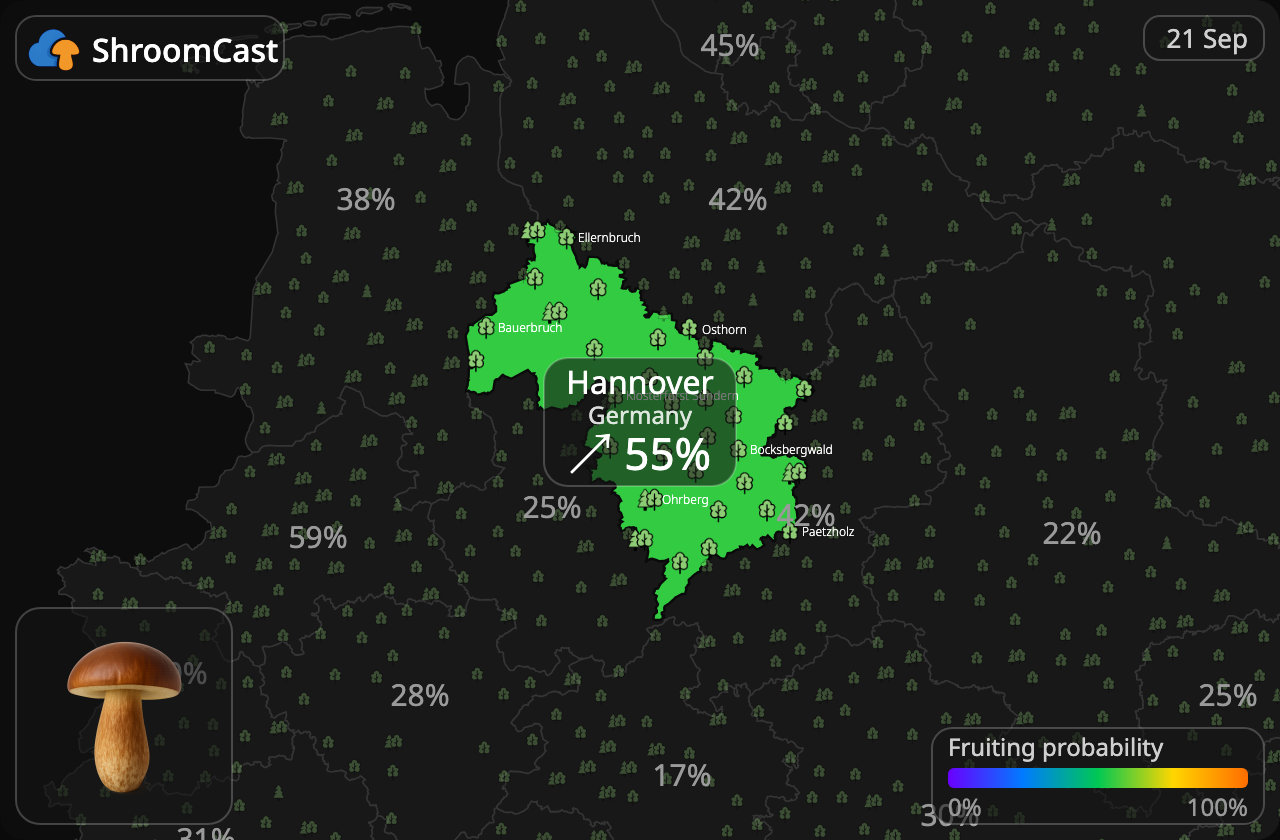
Updated 21 September 2026
Are Bay Bolete out in Hannover yet?
The best time for bay bolete in Germany is August to November, with the peak normally in the middle of that range. Today they’re at 55% and looking good in Hannover
It fruits after late summer and autumn rain once soil temperatures have cooled, typically from August through November. A good soaking followed by mild, humid days brings flushes, and it tolerates cooler conditions better than many boletes, often fruiting late into the season.
Often shares acidic conifer ground with other edibles such as the slippery jack, larch bolete and saffron milkcap, and you may find it near chanterelles in mossy patches. In the same beech and oak woods you may also encounter ceps and other Boletus species.
Its pale yellow pores and cut flesh stain a slow blue-grey when bruised or exposed to air, a harmless reaction caused by oxidising pigments that disappears on cooking.
A reliable test is to press or bruise the pale yellow pores, which slowly stain blue-grey, then fade; this and the bay-brown cap help separate it from the bitter Tylopilus felleus. Pick young specimens with firm flesh, as older caps quickly become spongy and waterlogged, and check for maggots in the stem before bagging.
Use fresh within a day or two, kept loosely in a paper bag in the fridge rather than sealed plastic. It dries very well sliced thin on a rack or low oven, and the rehydrated pieces plus their soaking liquid keep good flavour; sliced caps can also be sauteed and frozen.
It can be confused with the cep (Boletus edulis), which is also edible, but the bay bolete is darker brown and its pores bruise blue-green whereas cep pores do not. No common European bolete with which it is confused is deadly, but always check that the pores are not red or orange and that any blueing is slow, to rule out the few unpleasant blue-staining boletes.
FAQ
How does the live bay bolete forecast for Hannover, Germany work?
We take the usual bay bolete season for Hannover, Germany (August to November) and weigh it against the weather right now and over the last few days. That gives you one live number, today 55% and looking good, plus a 14-day outlook and a normal-year line to compare against.
When is bay bolete season in Hannover, Germany?
In Hannover, Germany, bay bolete season usually runs August to November. The exact start shifts year to year with rain and temperature, so some years they show up early and some years late. Right now (September) the live forecast for Hannover, Germany reads 55% and conditions are looking good.
Where do bay bolete grow in Hannover, Germany?
Grows in conifer woodland, especially with pine and spruce, and sometimes under beech and oak on acidic, often sandy or mossy ground. It is mycorrhizal and frequently fruits on or beside rotting stumps and conifer litter. They tend to come back to the same kinds of ground year after year, so once you find good cover it is worth checking again. ShroomCast does not share exact spots; it tells you the timing for Hannover, Germany so you know when it is worth heading out.
How do I know bay bolete season has started in Hannover, Germany?
Season usually kicks off after a warm spell followed by steady rain, with the first flushes appearing somewhere in the August to November window. The clearest sign is the live forecast lifting off zero into ‘just starting’ or ‘building’. For Hannover, Germany it currently sits at 55% and is looking good.
Are bay bolete out near me right now in Hannover, Germany?
Today the bay bolete forecast for Hannover, Germany is 55% and conditions are looking good. That is a live read for the region this September, and it shifts with the weather rather than following a fixed calendar. It tells you if it is worth heading out in Hannover, Germany right now.
See the live regional forecast in the ShroomCast app.
This page shows today. The app gives you the full 14-day outlook for your area and all 14 species, so you can pick the right day before you drive out.


Scale: 0-20% very low · 20-40% low · 40-60% moderate · 60-80% high · 80-100% excellent. ShroomCast forecasts fruiting probability from weather, soil, forests and years of observations – a guide, not a guarantee of finds.
ShroomCast forecasts the region and the time of year. It cannot identify mushrooms for you, so confirm any species with a reliable source before eating it.